
 The creation by Walt Disney can reveal and was greatly nourished by the mainstream American culture (: its aesthetics, political ideology, social structure, economic framework and moral principles.) Therefore it can reveal much about the American life. At the same time, the consumption of these entertainment products, the way they were received, understood, and interpreted by his audience- is equally revealing. Therefore, in the following three projects, I would focus on what Disney made and what was made of Disney.
 1, Snow White
Snow white is the first feature-length animated film, it nearly includes almost all first thing in animation field.
Character:
The following characters of Disney’s animation were gradually developed in the early stage. And even with the studio’s gradual move to live-action film in the 1950- 1960, they still remained strong.
A: Rural Romance. Walt Disney grew up in a small town, so his love for this village was genuine. There is a detailed argument in The Magic Kingdom, by Steven Watts about this point:
What made this town such a reservoir of inspiration for Disney's imagination, especially since his actual contact with it was so limited? But why American audience responded so enthusiastically to this personal vision?
(This pharagraph mainly discussed why Disney liked rural romance, because he don’t really understand the rural area, so he places human being in an ideal relationship to the natural world. As for why American audience like rural romance as well, because the amount of immigrant greatly increased at that time, and the town’s number decreased sharply…..
In snow white, there are a lot of natural scenes, they are quiet, harmonious, animal is innocent, cute. With the rural romance, snow white softened the industrial world. It let people smile together over something sweet and innocent and clean, let them forget the modern world beset by war, crime and economic strife.)
What made this town such a reservoir of inspiration for Disney's imagination, especially since his actual contact with it was so limited? But why American audience responded so enthusiastically to this personal vision?
…… Disney insisted on the value of deep root in rural community precisely because his own roots ran so shallow. The desperation of his grasp for this ideal stability only revealed the ephemeral nature of its object ……
particularly in the broad transformations in early decades of the 20th centuries, flood of immigrants from southern and eastern Europe ….. small-town 1880 to 1920 was beginning a period of rapid decline …..The audience suffered from the dislocations of historical change …..
 B: Sentimentalism and Criticism:
“Disney’s productions are films whose stock in trade is emotion, often construed in a negative mode within academic criticism as conservatively sentimental …… inventing animals with exaggerated features that enhance their cuteness, creating characters out of stereotype that are finessed by charm and humor…..” –The idea of Nature in Disney Animation by David whitley.”
(Unlike the traditional sentimental, Disney’s animation make a play for our feelings ….. such as the animal helper and dwarfs. and this kind sentimentalism was accepted by the audience.
Unlike the popular art, D's animation is more focus on how to provide young audience with a cultural arena within which heightened emotions and humor. They often carried social criticism, although immersed in fantasy and sentimentalism. Moreover, this critical instinct flourished alongside the golden age of Disney.
 D: Other factors: A success story where good triumphed over evil and progress over came adversity; a charming story of virtue, kindness; happy family. All these attributed to the personality of Walt Disney and his experience of early life. These characters further carried forward in Snow White.
 What Snow White made in the aspect of technique?
Because it is the first feature-length animated film, the studio confronted great problem, and they invited some modes and methods which served the animation well, and they continued to be used in today’s 2 dimensional animation production.
1, the multiplane camera and the real illusion of depth
Because the studio preferred to naturalism, the real illusion of depth is necessary in animated movie. For example, when you drive toward a group of mountain, the mountain nearby and the mountain far way will increase in size, but they increase at different rates. They developed the multiplane camera, which can move several pieces of layers past the camera at various speeds and at various distances from one another. This creates a three-dimensional effect. By this device, the animator can produce an accurate sense of depth.
2, the rotoscoping system
Because animating humans is difficult to draw becuase everyone knows how person move. They devise the rotoscoping system to film the image of live actors as guide for animators. They traced the movement of live actors frame by frame, and then projected these images onto the glass panel. Animator then draw on the panel. This device has been in recent years. (Actor usually wear back cloth before the blue background……..)
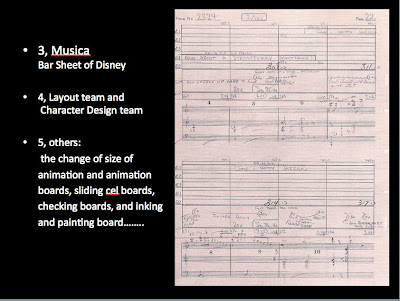
3, Music
They blend legitimate and illegitimate instruments together to sound like no orchestration that had ever been heard before.
Here is a Bar Sheet of Disney. The three upper staves E1 E2 E3 are devoted to instructions for three effect tracks. D1 and D2 are staves carrying the words to be spoken on the two dialogue tracks.
 4, Layout team and Character Design team is advanced.
Because an animated film must be cut in advance, since animation is so costly that the producer cannot afford to shoot extra footage. So layout team set up to regulate to avoid waste. They usually cooperated with the director and story team. They are responsible for deciding how the film would look like. For example, Character and background are designed by other team, but it is the responsibility of layout team to make these inventions work within the final context of the film.
The Character Design is advanced by now, the animation team began to take shape.
5, the change of size of animation and animation boards, sliding cel boards, checking boards, and inking and painting board……..
In this animation, there is a breakthrough of the use of camera movements, effects animation, and other technical devices.
 2, Fantasia [ fæn'teizjə
It is a full- length feature film which would take the form of a concert of orchestral pieces conducted by Stokowski and illustrated by the D artists.
The populist dimension of Fantasia
caused a sensation when it premiered.
“ Disney’s highly experimental concert feature caricatured or gently satirized stiff , elitist element of high culture. All the work in Fantasia deflated the diginity of classical music and bring it down to earth with a thud…..Disney intent to use Fantasia as a vehicle to bring high art to the people. He clearly explained his rationale for the movie at one point: ” We say that the public would always recognize and appreciate quality”
Listen hundreds of pieces of music first in order to evaluate them in term of their potential as a basis fro animation. Then investigate the story potential inherent in each of these.
It provided a field day for the D effects department. Almost 60 peoples worked to interprete the music in terms of abstract and semiabstract forms.
D developed a sound system utilizing seven tracks and thirty speakers, which anticipated stereophonic sound
There have been few moves in the entire history of cinema to compare with it in terms of boldness of concept and brilliant execution.
 3, Disneyland
This is one paragraph carved on the monument in Disneyland: Disneyland is dedicated to the ideals, the dreams, and the hard facts that have created America....with the hope that it will be a source of joy and inspiration to all the world.
Disneyland was opened on July 17, 1955. Television crews record the opening ceremonies. Millions more witnessed the event on their home screens. Disneyland became a national phenomenon overnight.
Disneyland conform to the principles had evolved while making his animated films.
 How Disney animation directs the design of Disneyland?
1, Disney character would be found throughout. Each part of Disneyland has a specific atmosphere based on different Disney animation. People can visit places where only the camera had taken them before.
The Disney’s designers quite understand how to establish the atmosphere of the theme parks. For example, the Modes of transportation, from horse-drawn trolleys to rockets.
The sense of structure and continuity was new to this kind of enterprise at that time.
 2, The narrative skills were employed in planning the lay out of the park. Usually in animation, one scene must lead to another one to create a narrative flow. Audience just passively receive, but in theme park, visitor is free to choose different theme based on different order, He can act as different roles, as if in an interactive video game to write his own story. The basic elements have been carefully preplanned by the designer. So maybe the cart and trolley is the camera which carries the audience through the narrative.


3 Disney artists' many years’ experience with animation is very useful in the technique, audio-animatronic figures. Here is a introduction about this device:
In such device, the sound is recorded on magnetic tape, sound impulses triggered mechanisms, buried within lifelike plastic figure that could control movements down to the flicker of an eyelid. Later, computer chips and other electronic innovations helped make the mechanical figures still more sophisticated.
Disney artists' many years’ experience with animation is very useful in the technique. They understand, for example, in two-dimensional animation, that a sense of reality may often be best expressed by suppressing or limiting movement. A character may express surprise more effectively by raising an eyebrow than by throwing up his hands in shock. Such as "Great moments with Mr. Lincoln."
 DL exploited genres of popular culture that had already demonstrated their staying power, and it capitalized fully on the established D image. Every element had been thoughtfully considered and imaginatively developed.
D's tradition has become coded into their synapses, and they could not shed it if they wanted to. Whatever they do in the foreseeable future, however innovative, will be touched by D's vision.
The Magic Kingdom, by steven watts
The art of Walt Disney, by Christopher Finch
The idea of Nature in Disney Animation by David whitley.
Disney and his world by Alan Bryman


